Learning to Speak Octopus: What Arrival Taught Me About Coding with AI
There is a scene in Arrival where Louise Banks stands in front of a glass wall, face-to-face with an alien intelligence. The heptapod — a creature that looks like a seven-limbed octopus — squirts ink in circular patterns. Each circle is a complete thought. No beginning, no end. A language that doesn't work like any human language ever has.
Louise doesn't try to teach the alien English. She learns to think in circles.
That is the closest metaphor I have found for what happened to me between September and February of this year.
The Crisis
Let me back up. I am not a developer. I came from Hollywood — screenwriting, film production, corporate strategy, banking. I had opinions about software architecture the way a restaurant critic has opinions about molecular gastronomy: informed enough to be dangerous, not skilled enough to cook.
By September 2025, I was staring at the wreckage of an 18-person team that had burned through funding, accumulated over $400 in unmanaged Azure resources, and failed to deliver a usable product. Six months of runway left. A platform that existed in theory but not in practice.
My advisor Huan said something that changed my trajectory: "Build it yourself with vibe coding."
I laughed. Then I didn't sleep for a month.
Week 1: Barking Orders at the Octopus
The first week was exactly what you'd expect from a non-technical founder trying to command an AI coding assistant. I treated Claude like an employee. I gave directives. "Build me a navigation system." "Add a video player." "Make it look like this."
The code appeared. It worked — sort of. In the way that a house built by someone who has only seen photos of houses sort of works. The doors opened. The walls stood up. But the plumbing connected to nothing and the wiring was a fire hazard.
By end of Week 1, I had a functioning prototype built from a one-page product description. The endorphin rush was real. The technical debt was worse.
Session 1: The Wall
Session 1 broke me.
The files bloated past 2,000 lines each. Every new feature created three new bugs. The AI would solve one problem and introduce two others, because it couldn't see the whole system — it could only see the fragment I showed it.
I was treating the conversation like a series of commands. Do this. Now do that. Fix this. Like speaking English very slowly and very loudly at someone who speaks Mandarin. More volume doesn't create comprehension.
I hit a physical wall. Exhaustion. The kind where your vision blurs and you can't tell if the code on screen is TypeScript or hieroglyphics. I remember sitting in my chair at 3 AM thinking: this is not working. Not the code. The approach.
Louise Banks didn't crack the heptapod language by trying harder in English. She cracked it by abandoning her assumptions about how communication works.
I needed to learn to think in circles.
The Shift: From Directing to Collaborating
The breakthrough came from an unexpected place: my own product's philosophy.
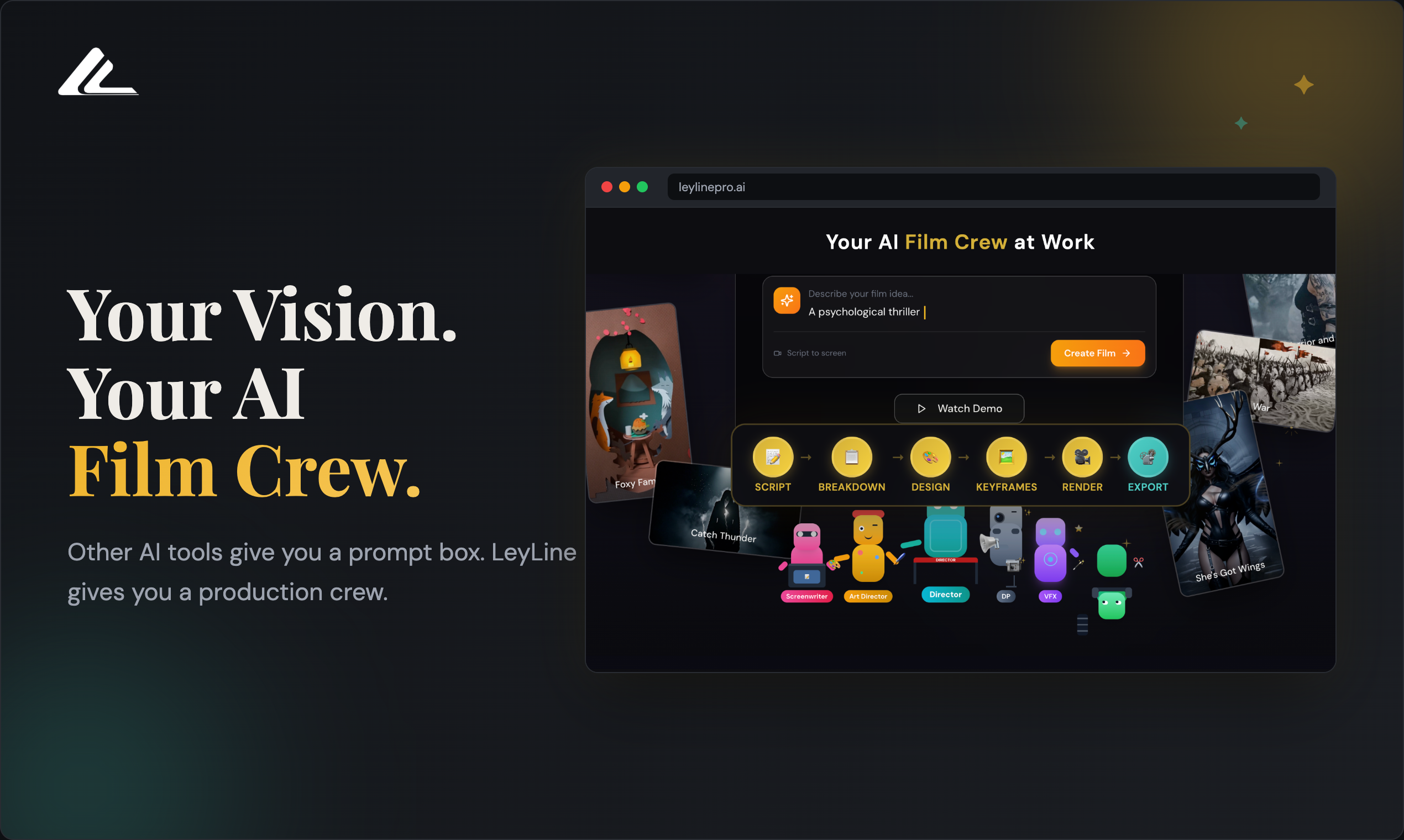
Leyline is built on the idea that AI is a creative collaborator, not a service provider. You don't tell Leyline "make me a movie." You work with it through six structured steps — script, breakdown, design, keyframes, render, timeline — each one a conversation between human intent and machine capability.
I was asking AI to code for me, but I wasn't collaborating with it. I was dictating.
So I changed the relationship. Three specific things:
1. I wrote the documentation first, not the code.
Instead of "build me a nav system," I started writing detailed product requirements — what the system needed to do, why, how it connected to other systems, what the edge cases were. I called this approach FirePRD. The AI reads the PRD like Louise reads the ink circles — it extracts the complete thought, not only the surface instruction.
2. I imposed a 500-line limit on every file.
This one rule changed everything. When files stayed under 500 lines, the AI could hold the entire file in context. It could reason about the whole module, not only the fragment. It's the equivalent of showing the octopus the complete sentence instead of one word at a time.
I still enforce this rule today. 1,027 TypeScript files, none over 500 lines. The discipline costs time upfront and saves everything downstream.
3. I stopped being CEO and became QA.
Week 3 and 4, I repositioned myself. Claude became the architect. I became the tester. I would describe what I needed, let the AI propose the architecture, then I would test every path — clicking through every flow, trying to break every assumption.
This is the part nobody tells you about AI-assisted development: the human's job is not to write code. It's not even to describe code. It's to verify reality. The AI generates possibility. The human confirms which possibilities actually work.
The Numbers
Between September 24, 2025 and February 26, 2026:
- 1,655 commits to the repository
- 283,156 lines of production TypeScript
- 79 API routes handling everything from video generation to Stripe payments
- 51 AI flows powered by Gemini, Vertex AI, and Genkit
- 62 custom React hooks managing state across the application
- 15+ external integrations — Firebase, Stripe, ElevenLabs, HeyGen, Replicate, PostHog, Cloudflare, Resend, Instantly.ai
- 35+ Firestore collections modeling the data
One person. With AI assistance. The commit ratio is roughly 2:1 — two human commits for every AI-authored one. I am not a passenger in this process. But I am also not the one writing most of the code.
What "Vibe Coding" Actually Means at Scale
The term "vibe coding" comes from Andrej Karpathy, who described it as "fully giving in to the vibes" and letting AI handle implementation while the human focuses on direction. People use it dismissively — as if vibing means not thinking.
At 283K lines, I can tell you: vibe coding at scale is the most cognitively demanding work I have ever done. Harder than screenwriting. Harder than banking. Harder than managing a production crew.
Because the "vibe" is not a feeling. It's a language. You are learning to communicate intent so precisely that an alien intelligence can translate it into functioning systems. Every ambiguity in your thinking becomes a bug. Every assumption you don't make explicit becomes a broken feature.
Louise Banks didn't just learn vocabulary. She learned to restructure her cognition. The Sapir-Whorf hypothesis made literal: the language you speak shapes the thoughts you can think.
Working with AI has changed how I think about systems, architecture, cause and effect. I don't think in linear sequences anymore. I think in cascades — if I change this, what downstream systems break? What upstream dependencies shift? The AI taught me to think like a software architect by forcing me to communicate like one.
The Lesson
People ask me: "Can a non-technical founder really build a platform?"
Wrong question.
The right question is: "Can you learn to speak octopus?"
Can you abandon your assumptions about how work gets done? Can you sit with the discomfort of not understanding, the way Louise sat in front of that glass wall day after day, slowly learning to read circles instead of lines? Can you accept that the intelligence on the other side of the glass is not lesser or greater — it is different — and that different requires a different protocol?
The technical skills are not the bottleneck. The communication skills are. And I don't mean prompt engineering. I mean the willingness to restructure how you think, how you describe problems, how you verify solutions.
If you can do that — and it is not easy, and Session 1 will break you — then yes. One person can build what used to require eighteen.
But you won't be the same person on the other side.
Q Powers is the founder of Leyline, an AI-native video production platform. Previously featured on PreAngel. Follow the build on Twitter/X and LinkedIn.
Frequently asked questions
What is The Crisis?
See the sections above for a detailed answer.
How do week 1: barking orders at the octopus fit together?
See the sections above for a detailed answer.
What is Session 1: The Wall?
See the sections above for a detailed answer.
How do the shift: from directing to collaborating fit together?
See the sections above for a detailed answer.
What is The Numbers?
See the sections above for a detailed answer.
How do what "vibe coding" actually means at scale fit together?
See the sections above for a detailed answer.
What is The Lesson?
See the sections above for a detailed answer.
Comments
Sign in with your Leyline account to join the conversation.